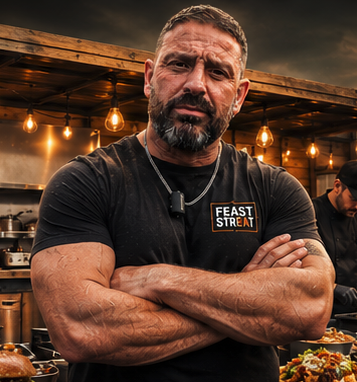
Since 1889: How a Family-Run Dairy Farm Milk Round Became A Multi-Million Pound Events Catering Operation
My family have traded in the street since 1889. Four generations of it, and I've been at it in one form or another since I was three years old. So when people ask how Feast Streat started or how it became a company that feeds some of the biggest events in the country, the answer starts more than a century before any of that, with a horse and cart in 1889. Queen Victoria still had 12 years left on the throne, the same year the Eiffel Tower opened, the year the very first Football League season ended. There were no cars on the road, no planes in the sky. No one had telephones or televisions and the streets were lit by gas and worked by horse.
It started with a milk round in West Bromwich, in the heart of The Black Country. My great-great-grandfather had a dairy farm, and my great-grandmother's job was to take the milk round door to door — a bell in one hand, a horse whip in the other for anyone who gave her trouble. She was a stern woman. After the First World War, which my great-grandfather came home from with shell shock, they moved into fruit and veg. First on a hand-made cart and then and onto West Bromwich market. Some of my family still trade in that market today over a hundred years later.
I was closest to my grandfather. I was his eldest grandson and we did everything together; I still wear his ring. He was up and on the market at one in the morning, building fruit displays you wouldn't believe and polishing every apple until there wasn't a fingerprint on it. Dragged along to help him sell fruit and partly to keep me out of trouble, inadvertently soaking up every bit of market trading wisdom he had to offer. The precision and creative flair he honed in flashing up the stall, the community he helped build and the relationships he had with his regulars, and even the banter he had with newcomers to win them over. It’s in my blood. I also grew up around the big Sunday markets run by my family's business, LSD Promotions — litter-picking at the end of the day, going round collecting the rents when it was all still cash. My mom was the real boss of that operation, whatever the paperwork said. And the thing my parents did brilliantly was treat everyone the same. Every trader, whoever they were, respected and looked after. That's why their business worked, and it's a lesson I never forgot.
“There’s got to be a better way…”
Working those markets every weekend, week after week, I ate a lot of bad market food. As a fussy vegetarian kid, it was rough. But it was rough for anyone even if you did eat meat. I kept thinking there had to be something better than this. So a bit over twenty years ago, my wife and I decided to try. We didn't call it street food (nobody did yet because it didn’t exist). The boom hadn't happened and absolutely no one knew what gochujang or bao buns were. But we knew we wanted to shift the image, away from the stigma outdoor catering had back then. I’d been over to Europe on a stag do with my mates and had been inspired by how they did it over there.
Back home and ready to build something for ourselves, we flashed up a marquee, imported the same Spanish paella pans I’d seen abroad, and thought hard about what to sell. Paella or Venezuelan food sold out of a shipping container would have been too big a leap for people back then, so we kept it simple and did it properly: hot dogs; something people were very much accustom to seeing, but instead of the dirt-cheap brine soaked jarred sausages and dry buns, we used award-winning pork from Wenlock Edge farm who reared their own pigs, fresh bread delivered from a local bakery that morning, and real onions, chopped coarse and reduced down, not the dehydrated onion porridge slop we were used to in those days.
The smell carried right the way across the market. People came looking for it, and when they found it they'd never seen anything like it. It sounds bonkers now. They were just good-quality hot dogs cooked alongside fresh onions in a big paella pan. People wouldn’t bat an eyelid these days but the mid-2000’s were a different world entirely. Tony Blair was still in office, Big Brother was at it’s peak and the kids all had weird fringes and spent their days on MySpace.
Our USP was simple: quality. Back then that was rare enough on the markets to build a business on. We got asked to more and more events, badgered our way onto the Birmingham Christmas market as its first street food trader (I don't think the organiser gave in because he wanted us, I’m pretty sure he gave in to shut me up), and grew the stall from six metres to twelve so we could do more.
I thought I'd cracked it
Then I made the classic mistake. I decided I'd outgrown the markets. I sold everything and moved into bricks and mortar; bars, restaurants, sandwich shops, even a 4,000-capacity events venue. I told myself markets were just a starting point and this was the natural next step. It was arrogance, plain and simple. I'd expanded into things I didn't understand anywhere near as well as I understood my own trade, and when it came apart, it came apart fast. I lost the lot, and I was back at square one, working out where to go from nothing. That's the part I'm least proud of and learned the most from. I'll come back to it.
Back to the market and times had changed…
I went back to what I knew. I started again on the market and rebuilt Feast Streat from scratch. By then, street food had properly boomed. Great independents everywhere, brilliant food from all over the world and the public were lapping it up. Consumer behaviour had changed drastically and they were itching for new, exciting and exotic food. Which was the problem: my old USP was gone. Quality alone didn't set you apart anymore, because everyone had it. So I went looking for a gap and eventually and I found one. There was a big void between two kinds of caterer. On one side, the independent street food trader: amazing food, but not built for huge volume. On the other, the large-scale show caterer: could do the numbers, but the quality often wasn't there. Nobody was doing both. That was my lane, right down the middle of it.
The idea became the whole company: give large-scale organisers a single supplier who could bring a range of restaurant-quality street food brands, at volume, fully compliant and safe, with queue times under control, so they could hand the whole food operation to one team and stop worrying about it. That's still exactly what we do, 21 years in. And I've never once compromised the quality. If someone asks for a cheaper, worse burger to hit a price, the answer is no. That's not our model, and it never will be.
Building the machine
Proving the model needed a shop window, so together with LSD we built a permanent food court at Waterside Market, somewhere event organisers could come alongside the public, try the food, see the service and picture it at their own event. Food courts, indoor or outdoor, are the future as far as I'm concerned: grouping food together creates atmosphere and a proper dining experience, rather than dotting it around a site.
Then the reputation started to travel. One festival came to us in a mess — awful queues, poor food, the experience getting torn apart on social media, and the sense that they had one chance left before people stopped buying tickets. We put in 72 metres of street food that some of the other traders nicknamed "the Great Wall of Street Food," with big back-of-house kitchens, trucks full of refrigeration and teams of chefs. Quality went up, queues came down, and we fixed it for them.
Jobs like that forced us to build a proper business behind the food. An operations room for briefs, debriefs and planning. A central distribution base in the West Midlands, where everything is picked and packed for the exact menus going to each event. And a few years ago we went cashless. Partly for the data, which is now fundamental to how we run. My Operations Director Scott Fellows (far better at this than me) built a system that acts like the brain of the business: feed it the weather, past sales, footfall and the menu, and it forecasts the stock, works out which truck it goes on and where it's placed on site, and prints the exact ingredients, packaging and cleaning products needed. It's all picked from those sheets and sent out nationwide. We also put our staff on payroll rather than using agencies, so they're trained on our system and it's never a stranger trying to work out how we do things.
Who we work with now
That structure is what let us work with some of the biggest names there are. We do a lot with Live Nation and some of the biggest festivals in the country like Download Festival, Creamfields, Adventure Bike Rider Festival etc. We travelled the world with Bowler Motorsport, the Land Rover Defender rally team, then owned by Jaguar Land Rover, immersed in their team, in their branding, cooking for their drivers and pit crews wherever they raced (including tapas for them in Spain). We've done genuinely odd, brilliant jobs: street food for Kellogg's senior board in the empty pool of a disused swimming baths in Manchester; an Amazon job where they needed 40 people fed every 40 minutes — a minute a head, a man stood there with a stopwatch, because any longer would cost them parcels.
And we work right across Arena Racing Company's 16 racecourses, serving their big race days with different concessions in different locations — flexing to high volume without dropping the quality. Most recently we've built our own semi-permanent timber structures that go in and out on a one-day commission but look far better than a temporary stall, good enough that our racing client asked us to leave them in permanently.
What it taught me
I promised I'd come back to the hard part. Losing everything and starting again was the making of me as a business person, even if I'd never choose to do it twice. The biggest lesson was about ego. I'd looked down on my own family's industry — thought I was better than the market, that I'd moved on. I was wrong, and I'm a bit ashamed of it now, because the markets were good enough for my grandfather and everyone before him, and they're the foundation of everything I've built. My advice to anyone starting out is simpler than people expect: stay in your lane and do the thing you're genuinely good at. Stay passionate, make sure it's viable and above all, manage your cash flow. Profitability matters, but cash flow is what keeps the doors open. Get the passion and the cash flow right and you'll get there.
That's also why I sit on the board of the National Market Traders Federation, and why we do a lot of work with young traders and in schools. Markets are where my family's history was built and where our reputation for quality was made. They're still our shop window, and they're still where we test ideas and stay honest. For us, markets aren't the past. They're the foundation and the future, both at once.
We feed events across the country and beyond now. But it still comes back to a milk round in West Bromwich, and doing it properly. That part hasn't changed, and it won't.
ABOUT FEAST STREAT
Feast Streat is a UK turnkey street food catering company with its HQ in the West Midlands. We provide complete, single-supplier event catering: modular pop-up food courts built from our own trucks and hand-built timber concessions, serving 25 cuisines from 20+ in-house brands. We're fully self-sufficient (our own power and LPG), and we handle logistics, compliance, allergy management and waste in-house. We cater corporate events and brand activations, festivals and public shows, and stadia and arenas across the UK — around 400 events a year.
Planning a festival, corporate event or private function?Get in touch — enquiries: bookings@feaststreat.co.uk.