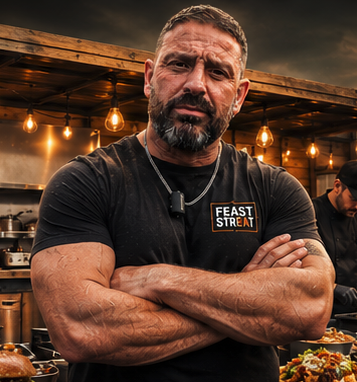
How Do You Know an Event Caterer Won't Cut Corners on Ingredients?
The short answer: because a good caterer tests a product under the worst conditions before it ever reaches your guests, and holds every ingredient to the same standard: is it still right for the customer? Here's exactly how we do that at Feast Streat, using a real example from last year.
The test that most caterers never bother to run
One of our core ingredients is a skin-on, gluten-free premium fry we buy from Booker. We quite literally go through tons of it a week — it's the base of some of our best-selling loaded dishes, and customers have come to expect it. I know the product about as well as anyone outside Bookers’ own team, because I advise them on the hospitality side. So when Booker announced they were rebranding that product by moving it from a mid-range line to a premium one, and making a recipe change - a lot of people in the trade got nervous. Would a chip that used to hold its crunch now turn to mush the moment it was covered in toppings? I heard the concern first-hand, so I went and tested it. We didn't take anyone's word for it.
We took pre-launch bags to one of our units at Worcester Racecourse and ran them under the harshest conditions on our menu: a slow-roasted beef brisket in peppercorn gravy, a smoky Louisiana pulled pork, and our cheesy fries, which is mozzarella, cheddar and lashings of liquid nacho cheese, all of them heavy, wet. If anything was going to turn a bad chip into a bowl of mashed potato, this was it. Then we let them sit. Five, ten minutes under all of the sauces, longer than any guest would have the restraint to wait before tucking in. They held. Skin-on, still crisp, still crunching under a full load of brisket and gravy. We were happy, and so were the staff who got to spend the first half of their shift stuffing their faces testing them out. Even James, our videographer got stuck in (not that he needed much encouragement). We went a step further and as one of Worcester Racecourse’s in-house chefs from their corporate hospitality team walked by, we dragged him over to the unit. He dutifully taste-tested them all and after an impromptu break and free lunch, we were safe in the knowledge that the chip we rely on week in, week out was still as reliable as ever.
Why this is really a story about your event and not really about chips
This matters if you're booking catering for a corporate event or a public show: the chip isn't the point. The due-diligence is the point. Plenty of caterers will accept whatever a supplier ships and find out on the day whether it works; right in front of your guests. Our rule is the opposite. Every ingredient has to earn its place under one test: does it still deliver for the customer? A relationship with a supplier doesn't buy it a pass. I advise Booker on hospitality and I still ran their rebranded fry under the harshest conditions on our menu before I'd serve it. The standard I'm protecting isn't Bookers, it's the crispy chip in your guest's hand and our hard-earned reputation after 21 years in the business.
That discipline is why, when you book Feast Streat, ingredient quality is one thing you never have to think about. We've already done the worrying for you — usually weeks, months or sometimes even years before your date, on a quiet afternoon at a racecourse, with a stopwatch and a serving of sauce and toppings so generous that would make our Operations Director wince (sorry Scott, it was for the greater good…)
What ingredient testing looks like in practice
We test before we launch. New or reformulated products get run under worst-case conditions before they reach a customer.
We buy on quality, not price. A cheaper input that lets a dish down is more expensive than the money it saves.
Supplier relationships don’t buy a pass. Even a product from a brand I advise gets held to the same spec, and tested the same way.
We tell you the truth. If a product had changed for the worse, I'd say so and disclose exactly where I stand while I say it. If they and turned into a bowl of mashed potato, I’d refuse to serve them and find a new chip supplier immediately. In this case it hadn't, and I'm happy to put my name to that.
Frequently asked questions
How do event caterers make sure food quality doesn't slip between the tasting and the event?
The reliable ones test products under worst-case conditions before rollout and hold suppliers to a fixed spec, rather than accepting whatever is delivered. At Feast Streat we trial new or reformulated ingredients — like a recently rebranded premium fry — under heavy sauces and long stand times before they ever reach a customer.
Will loaded fries go soggy at a large event?
Not if the base is right. A properly specified skin-on fry, cooked in hot enough oil, stays crisp under sauce even after sitting for ten minutes. We test exactly this before serving it at scale.
Do you use gluten-free ingredients?
The premium skin-on fry at the centre of this test is gluten-free. We can advise on dietary requirements for corporate and private bookings — get in touch to discuss your event.
What happens if a supplier changes a product you rely on?
We test the new version under real conditions before it reaches a customer. If it holds up, we carry on; if it doesn't, we raise it and hold the product to the spec — even for a brand we work closely with. Quality comes before the relationship.
Disclosure: I'm a Hospitality Advisor to Booker Wholesale, who supply the fries I write about below. I'm open about that relationship — it's on my LinkedIn — and it's the reason I know this product inside out. We literally sell tons of chips every year, so we need a chip we can absolutely rely upon. It's also why I put it through a harder test than most people would, and why I'll tell you plainly if something has changed. This is a hands-on assessment, not a paid promotion.